Wednesday, 25 March 2009

Customer service - getting better

Having bitched and griped before the way that Nuance Communication delayed the commerical launchof T9Nav until a week after the beta period ended, I have to give credit where credit is due.

I bought T9Nav, one of my rare treats to myself, from Nokia's Appstore (sorry! Software Market!).

Today, I received an email directly from Nuance Communications, saying:

"Attached is the upgrade version of T9 Nav, version 2.0.1. We’ve fixed some issues with SMS indexing and recommend that you use this version instead of the original."

Okay, that's better. I was scratching my head and wondering what would happen if they ever did upgrade, and now I know.

Well done.

Friday, 20 March 2009

After the Internet, let's burn all the books. Nobody'll mind that, will they?

When I was in high school, and a keen but untutored debater, my team were affirmative in a debate on the topic "That censorship is an insult to the intelligent." At one point, one member of the opposing, negative, team pointed at various military hardware posters around the room and tried to use them as an example for a point he was making, but clearly didn't know what any of them were.

When I stood up, third speaker for my team (I always was), I went around and named each piece of hardware - helicopter or aircraft - to make the point that I was more intelligent than he was. I then used the story of how Tom Clancy had been threatened with a military court-martial as a spy because the details of anti-submarine warfare he had outlined in Hunt for Red October were so accurate. He had to take the military to his local library and show them how he had pieced together a plausable explanation from publicly available data. They let him off. Well, they had to (although today he might find himself in Guantanamo Bay before they had given him a chance to explain anything. That, however, is a different story).

Despite my inability at the time to remember the name "Tom Clancy", we won that debate and rightly so. Apart from being better debaters, we were right.

Censorship is an insult to the ingelligent, and it is an insult to voters in a democracy. Unfortunately, because so few of the people calling for it are actually intelligent themselves, it's got a good chance to get worse.

I am referring, of course, to the planned Great Firewall of Australia, the Berlin Wall dreamed up by Canberra, the national, mandated, non-opt-out, Internet filter.

I haven't said much in these pages, simply because I haven't much on anything over the past few months.

Every now and again, however, I get a head of steam up and feel that it is my duty to publicly insult the stupid.

I refer you to an article in the Australian entitled "Internet filter list of porn exposed".

Problem number one is that, as other commentators have already discovered and noted, it's not a list of porn at all. It's a lost of mostly porn, with the odd pet shop or dentist or poker or betting website thrown in for bad measure. So, shame on you The Australian.

This is the background:

The Australian Communications and Media Authority, the ACMA, maintains a list of sites which have been reported as offensive. This includes directly illegal content, specifically and most vocally child pornography, but also legal but reported-as-offensive-by-somebody content such as graphic anti-abortion websites, perfectly legal over-18 pornography, content which has been refused classification in Australian and is therefore not technically, actually, banned, and poker websites. That's the card game, not anything else you may think of from the pronounciation of the word "poker".

This list is used to create filter software so that, should families wish to download something from the government which restricts their internet viewing to only those sites not blacklisted by said government, which is a worrying sort of decision to make, they can do so.

The problem begins when the said government pledges to filter certain types of content for the entire country, whether or not you agree to this. They claim a mandate, of course, having won an election on the back of workplace and industrial relations laws and thereby clearly having been given carte blanche over telecommunications. If you can't see that perfectly obvious link then think of the children.

The list has, in a triumph of decency over paternalistic, fascist politics, been leaked to the website wikileaks which has, ironically, itself been put on the list for having leaked the lists used in other countries, and is available here, which is to say http://www.wikileaks.org/wiki/Australian_government_secret_ACMA_internet_censorship_blacklist%2C_6_Aug_2008 , and also, for good measure, at http://bit.ly/w3Gb.

Now: The ACMA says that the list is bogus. It may well be.

However, I don't wish to discuss the contents of that list, which are frequently hilarious, but the response to the list's release.

Let us dissect the Australian IT article itself.

Opening paragraph: "THE Rudd Government's plans for a nationwide internet filter are in jeopardy after its top-secret blacklist of banned web pages was leaked."

Excuse me? In jeopardy how? How on earth will people knowing what's on the list, affect the possibility of filtering the contents, apart from making somebody look like an idiot?


Moving on to paragraph two: "The list, published on the internet, reads like a White Pages of porn and its release has provided a handy guide for young people to access the very material the Government wishes to banish from their eyes."

I call time out for being an idiot. This isn't reporting, it's tabloid journalism. Here's another way to access a huge amount of the very material which the Government is trying to banish: www.google.com.

The White Pages at the very least tries to be comprehensive. This isn't even a decent yellow pages - the very idea that any list with less than about a million entries could possibly be any sort of comprehensive guide to anything on the internet is laughable.

Paragraph three: "The secret blacklist, which was leaked to the whistle-blower website Wikileaks, is purportedly the same list the Australian Communications and Media Authority distributes to vendors of approved internet filters to ban offensive material -- such as child pornography, bestiality and violence."

Violence is offensive? Since when now? Is www.wwe.com on the list? Or how about www.defence.gov.au?

"Senator Conroy has said he plans to use parts of the ACMA blacklist to block Australian internet users from accessing pornographic and violent material. Now the secret list has been made public, it is more likely it will be used by interested parties as a pornography database of unheralded proportions."

You have got to be kidding me. Who the hell wrote this tripe? Mitchell Bingemann, have you ever even been on the Internet?

"Child protection group Child Wise said whoever published the blacklist had opened up a pandora's box of porn."

No, sorry, the Internet did that.

""Every 15-year-old boy in thecountry is going to be after this porn list," said Child Wise chief executive Bernadette McMenamin."

I hate to break this to you Bernadette, but most 15 year olds masturbate, fart, tell each other filthy jokes and already know far more about their current tastes in porn than they could ever get from this list.

"Yesterday's disclosure of the blacklist could also jeopardise efforts to block access to offensive material as the perpetrators will now know they were tagged by the secret list."

Oh, who the fuck runs a child pornography website and doesn't already assume that they can be tagged?

I find the scariest part of this whole sordid mess of irresponsible journalism and rank head-in-the-sand squawking to be in the final paragraph (emphasis added by me):

"ACMA threatens fines of up to $11,000 a day for linking to sites on its secret censorship blacklist and said Australians caught distributing the list or accessing child pornography sites on the list could face criminal charges and up to 10 years in prison."

What the fuck? In other words, distributing a list of URLs is punishable in this country? How the hell did that happen?

In addition: How about everyone who's been fined puts their URL into a hat, and we can rebuild the list from first principles, hmm?

I'll leave the final word to Wikileaks themselves, as quoted in the article:

"While Wikileaks is used to exposing secret government censorship in developing countries, we now find Australia acting like a democratic backwater," the website notes.

"History shows that secret censorship systems, whatever their original intent, are invariably corrupted into anti-democratic behaviour."

And that, my friends, is why this must never be allowed to happen.
Further information:

Wednesday, 18 March 2009

Computers and customer service

I have just paid my electricity bill to Origin.

Quite apart from the sense of piercing pain that this always promotes, I noticed a few things about the automated phone system.

First of all, it doesn't make you talk to it and it's quite quick and efficient. So kudos there, then.

However...

You dial, it is answered almost immediately, and it says "To continue, press 1."

You what? Dial, wait two seconds, have to do something else just to do something else?

All right, moving on...

Enter biller code, reference number, amount to pay, credit card details  (all of them) and then... It reads it all back to you, so that you can check, and it does two things:

Number one, is it picks up a bad asian accent and says "three hundred dollar and sixty cents". Not "dollars", but "dollar".

Which amused me, mildly.

Number two is that when it reads you back your reference number, it messes it up.

The number is printed in the form "012 857 ..." and so on. In triples, which is a fairly standard way of doing things because triples are easy for the human mind to chunk numbers into to make memory easier. It is read back, however, as "01 28 57 .." - doubles. Which throws you a loop and leaves you momentarily unsure about what you're reading, therefore making it quite difficult to check that you got it right the first time.

Which isn't helpful.

But, having said that, it is just about the best telephone billing service I've ever used.

Thursday, 12 March 2009

Sensible medical reporting from surprising sources.

I am quite surprised to find myself mildly impressed by the Courier Mail.

Not an improved standard of journalism or decreased tabloidship - we're not that lucky.

They do, however, throw themselves behind awareness-raising and fund-raising for young carers, and now we have measles.

Over the past few years, the anti-vaccination madness which has seen the UK spiralling into an epidemic, and the USA lose its near-eradicated status as US-resident adults and children are hospitalised, has reached Australia. There have always been conscientious objectors, of course, but they haven't really been a problem because with so few of them, there's a herd-immunity effect - they're not likely to meet someone with measles, or rubella, or what have you, so they're not likely to become infected. So they won't get sick.

So they won't realise just what they're missing.

They're learning, however.

There have been recent outbreaks of diseases such as whooping cough and measles in small pockets around Australia, frequently in traditionally "alternative" (read: hippy) communities in otherwise attractive places like the hinterlands of both the Gold and Sunshine Coasts, on either side of Brisbane.

So they're learning what these diseases can do.

Some people, however, already know exactly what having measles means. Laine Bradley contracted measles before the immunisations started, at age 10 months, and was blind and unable to walk until she died at the age of 12.

Her mother, a nurse, spoke to the Courier Mail, who printed the story and who spoke to the Australian Medical Association and who ran a neat, reasonably tightly written piece with decidedly below-par levels of sensationlism.

This is more than I usually expect from that outlet, and I congratulate them.

Link to the Courier Mail article "Laine Bradley's mum joins measles outbreak debate"

Sunday, 8 March 2009

Shock: Personalities affect lifestyle choices

Vaughan over at the always good value Mind Hacks has found a study which claims that People who buy dog breeds recognised as being "vicious", tend to be arseholes themselves.

I paraphrase, of course.

Basically, a psychologist has used an anonymous online questionnaire (hmmm...) of uni students, assessing criminality and various personality traits associated with being a not-nice person, and correlating that data with reported breed of dog owned.

Setting aside the various problems with anonymous online surveys, the study found that people who buy Dobermans, Pit Bulls, Rottweilers, Wolf-mixes (not wolfhounds), or Chow-Chows (what?) are more likely to show more, more violent and more varied criminal behaviour, and are more likely to exhibit psychopathic and impulsive personality traits.

At first, and indeed second and third, glances, this looks like another study which has clarified an issue, probably needed to be done, but didn't really add anything new, did it? I mean, really.

The sort of person who owns a Doberman chose to own that Doberman. A person who thinks that an ugly, potentially risky brute like a Pit Bull will make a good pet is unlikely to be the sort of person who volunteers at the local soup kitchen, are they?

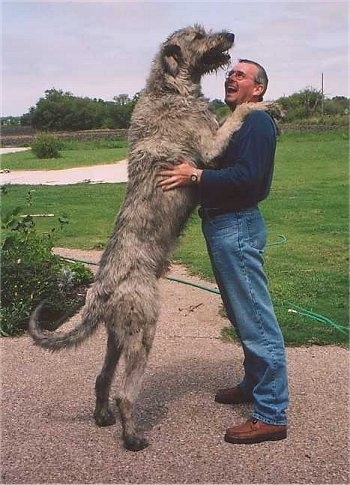
I'm not suggesting for one second that everyone puts as much careful thought and consideration into breed selection as my partner did when she settled on Irish Wolfhounds, but, I mean, really.

Ownership of the sort of dog which is banned by local councils or perilously close to being banned by entire countries, is unlikely to be an entirely innocent choice.

Either people want a violent guard dog, which may indicate that they have enemies, a severe dose of paranoia, or just generally don't like people, or; they want a symbol of toughness because  tattoos, obsessive gym physiques and a badly modified Commodore are no longer enough, or; they want a dog which will frighten people, or; well, add your own.

The problem here, the big problem here, is that dogs tend to become dangerous to humans only when threatened (including entering their territory), provoked (which basically means: threatened) or trained. Even Irish Wolfhounds, a breed regarded as being good with children because their temperament is so goofy, can become truly frightening if trained for pig hunting. Any large breed will automatically do more damage if they do attack people than a chihuaha will, and if a dog has been bred for characteristics which are good for hunting or fighting, such as tenacity or jaw strength, they will of course cause untold more damage.

Size and breed will make the difference between a badly trained dog being an annoying little shit, or a killer.

Sadly for many of these breeds, which can be highly intelligent, loyal and devoted, their reputation has made them preferred dogs for arseholes, which reinforces their reputation.

Which at least gives us a nice, obvious visual warning sign to go with the car, the bumper stickers and the T-shirt.

Link to Mind Hacks article Psychological characteristics of vicious dog owners

P.S.: Might I suggest that the title would be less entertainingly ambiguous if it were "Psychological characteristics of the owners of vicious dogs".

Tuesday, 17 February 2009

I'd like to think that the Church had a limited life expectancy, instead.

Now, this makes me really angry.

Church contests age expectancy of brain injured Myles Hill (Courier Mail)

That's not a very helpful headline, so let me give you the synopsis:

Myles Hill, now 17, suffered a serious brain injury while boogie-boarding at the Southport School in 2003. The Anglican Church, who I can only assume are responsible for the school, are denying culpability, pointing the finger of blame at so many other parties that one wonders if they're trying to snowball the court into submission.

I mean it, it really is ridiculous.

But, and here is the point that makes me see red, they are trying to limit the amount of damages claims by claiming that he won't live for very much longer.

To remind you: I have worked with brain injury. I dealt, day in and day out, with families who are facing inadequate care because they can't afford it, because the compensation funds ran out early. I have been at large meetings where services from different branches of public and private, health and disability and law and insurance, all agreed that a major problem with compensation payouts is that people with brain injury live longer than courts expect.

In fact, Disability Services Queensland have identified this issue, and the resultant need for publicly funded services, as a crucial one that needs to be addressed. Papers discussing PhD research on this issue are available from the Articles section of Gitana Consulting's website.

So, the fact that a Church, a pack of hypocritical bastards who have the gall to go on records as saying:

""While we respect the legal mechanism and the process, the church's focus is one of compassion and pastoral care," he said. "Our prayers and thoughts remain with Myles and his family.""

The fact that this church is pointing the finger of blame at everyone else and accusing the family of not being able to care for Myles, is saying "Oh, he's not going to live for very long, so the enormous emotional trauma you've already suffered and the added trauma of us telling you this is irrelevant, really, because someone with really high medical care needs isn't going to live long enough to need help", that is a candidate for a Scumbag Of The Year award.

It must be so easy to be religious, and claim that merely thinking happy thoughts instead of actually doing anything discharges all responsibilities, duties of care, and expectations of compassion. Useless pricks, the lot of them, living like a bloated appendix on the rest of society.

Sunday, 15 February 2009

Community needs to understand mental health, before commenting on it

I direct you to the ABC Online article Community urged to weigh in on forced mental illness treatment.

The gist is that a parliamentary committee in Tasmania has heard that the community needs to debate when it is okay to force treatment on someone who has a mental illness.

Michelle Swallow from the Mental Health Council, which is an advocacy group, so therefore Michelle is someone who is paid to represent people with a mental illness and, in more basic language, be a shit-stirrer, thinks that the individual should be able to decide unless they are considered a threat to themselves or others.

Umm... Excuse me, but I thought that was what the law currently is anyway?

Most states have a two-tiered system for "forced" (which is called "involuntary") treatment of someone with a mental illness: An Involuntary Assessment Order, which is usually 48 hours during which the individual can be collected by police, taken to a secure facility and detained while a psychiatric assessment can be conducted upon them, and; An Involuntary Treatment Order, during the course of which they may either be in a secure facility or in the community, but have to take prescribed medication until such time as the order is revoked or not renewed.

It's a little bit more complicated than a GP deciding that someone with a case of depression needs to be locked up if they don't want to take their medications.

Michelle continues, to say that there is a gap in the law which does not require a GP to specify why they have ordered involuntary treatment.

Really? Now that would be interesting.

Let's have a look at the law in Tasmania, available from Austlii, here.

Section 15 states that a police officer or authorised person may, using their judgement, take someone into protective custody. Well, just about everything to do with the police involves judgement, so if there's a problem here, it's one of training and supervision of police officers.

Section 16 states that the person taken into custody must be taken ASAP to an authorised assessment centre, the assessment centre must be notified within 2 hours and the person must be assessed and either released or have an involuntary treatment order written up within 4 hours. Now, honestly, 4 hours? Try getting seen within 4 hours if you turn up to emergency with any condition less serious than haemorrhaging blood or developing cyanosis.

So how about treatment, then?

Sections 24 through 30 deal with involuntary admission to hospital.

Section 24 covers admission, and I'm going to copy it verbatim. Are you ready? Here we go:


"A person may be detained as an involuntary patient in an approved hospital if –
(a) the person appears to have a mental illness; and
(b) there is, in consequence, a significant risk of harm to the person or others; and
(c) the detention of the person as an involuntary patient is necessary to protect the person or others; and
(d) the approved hospital is properly equipped and staffed for the care or treatment of the person."
See? Criteria. Right there. Spelled out.

The people who may make this order are given in Section 25, and basically amount to an authorised officer, which means someone appointed by the Minister (and more detail than that I am, unfortunately, unable to give), or the ill person's guardian.

Interestingly, Section 26 states that a medical officer at the approved care facility has to approve the application for admission. An initial order has to specify all the whos and wheres, and, crucially, a statement against all the points covered in Section 24. You may like, at this point, to go back up and read those four points. An initial order for admission has to specify the who, the why there's a risk of harm, the why the detention is necessary, and that the nominated hospital can actually do so.

Well, that all makes sense, doesn't it? Would you care to clarify, Michelle?

I'm thinking, and this is only a guess, mind you, that there are two separate issues here:

One, this paperwork is often not explained to the patient, who rings the Mental Health Council with a complaint, or; two, this is just an excuse to get a debate happening because either liberties are being taken, or because that's the MHC's job.

In my experience, working in both Tasmania and Queensland, there are a lot of often quite worrying or even scary people wandering about who should be on an involuntary treatment order, preferrably in a lock-up, and that most people with a serious mental illness who come to the attention of services such as drop-in centres or the MHC, deny their illness and believe that they are being persecuted, or are part of a government experiment, or are being made worse, or.... Well, fill in the blank, really.

No system is perfect. Particularly with mental health, where all assessments are judgement calls and there is no testable pathology and all criteria are behavioural and either observed (massively open to interpretation) or reported (massively suspect, in far too many cases), no system ever can be perfect

Yes, sure, the community needs to have a say in law and policy. But leave medicine the hell alone, and let the doctors do their job until the law itself is changed. The community interfering in medical decisions is a road to nightmare. Measles epidemics, say, or the suicide of someone with schizophrenia who was denied treatment on religious grounds.


Link to the Mental Health Council of Tasmania
Link to the Mental Health Act (1996) for Tasmania, on Austlii.

Search This Blog