Showing posts with label skepticism. Show all posts

Monday, 25 July 2011

A brief rant on evidence and debate quality - wind turbine edition


The ABC's 4 Corners has just broadcast an episode on wind farms and the people who claim they're hazardous to human health.

I knew it was going to annoy me and it did.

Even ignoring the people who say inane tripe like "What if a piece the size of a Commodore broke off?" (gee, what if a Commodore ran into someone? Or they, you know, like, built it properly?), the entire debate is, no real surprise, emotional and really, really poorly informed and generally lacking in any sort of science or, sadly, journalistic investigative rigour.

Here's the thing:

Lots of people are claiming they have health problems caused by wind turbines.

Nobody with any sense is claiming there are *no* health problems..

However, the central issue here is: Why? What is the causative factor? Is there any evidence?

Consider this:

  1. There is no solid evidence health problems are caused by wind turbines.
  2. There is some evidence wind turbines don't cause health problems.
  3. There is some evidence that earning rent from wind turbines is correlated with no health problems, which is an entertaining result.
  4. There are three health/causal possibilities:
    1. Health problems are caused by wind turbines (direct physiology - pressure waves, sound, infrasound, something like that)
    2. Health problems are caused by stressing about health problems that may be caused by wind turbines (psychotropic/psychogenic/psychosomatic - stress, most commonly).
    3. You have menopause, or an infection, or a pulled nerve, or something else completely unrelated to the wind turbines but the turbines get blamed anyway (probably a case of confirmation bias).

Now:

  1. If you are not interested in considering possibilities 4.2. and 4.3., you have nothing to contribute to this debate. However:
  2. If you are not interested in considering possibility 4.1, you have nothing to contribute to this debate.
  3. If you think "psychogenic" is an insulting term indicating weakness, go and say that to someone with severe PTSD. Preferably a former special forces soldier living on a disability pension.
  4. If you think "psychogenic" is impossible, go and say that to someone with severe PTSD. Preferably a former special forces soldier living on a disability pension.
  5. If you are just going to shout at me, piss off. You have nothing to contribute to this debate.

You may now enter the debate.

Sunday, 29 March 2009

Being reasonable as an offence against reason.

The ABC in Australia has started an interesting little panel question-and-answer program called, unsurprisingly enough, Q&A, in which highly experienced journalist Tony Jones moderates a panel of guests and fields questions from the website (in real-time, even) in text and video, and from the audience.

On it, this week, were Federal Minister for Telecommunications and Messing With it, Stephen Conroy, and also, among the others, way-far-right-wing newspaper columnist Andrew Bolt.

These two were key for two reasons: One, Conroy got sent more questions than Q&A had ever received on anything, ever, and never managed to give one straight answer in half an hour, and, two, Bolt is a warped travesty of a stereotype of a pundit.

The man managed to use most of the tools of illogic available to his kind: Misrepresenting his opponents and their arguments, warping the argument to suit himself, ignoring any counter-claim that he doesn't feel up to answering, cherry-picking facts, being annoyed when people throw him different cherries, and using the word "moral" as though it had an objective, concrete and unwavering meaning.

All of which would merely serve to provide one side of a debate, and prompt some good back-and-forth, were it not for the greatest sin of all:

Being reasonable.

You see, there is honour in honesty, and honesty in self-righteousness, and truth in bald statements. Yet being reasonable is to use the forked tongue of an insurance salesman to do the devil's work.

Beware, at all costs, these phrases:

  • "I don't want to appear [racist][sexist][whatever] but..." - This means that they're about to, but want some sympathy for being honest or for raising a painful point which people may sympathise with, at least a little bit. Be honest. Or, if you realise that you have to skirt tricky shores, be carefully exact.
  • "While I do concede that point..." - This is tricky, and can be used honestly, of course it can, but it often means "I don't agree with you, and I'm going to try and make you appear narrow-minded and stupid by being narrow-minded and stubborn."
  • "Surely nobody would argue that..." or "Nobody is really arguing that..." - This is usually used to make their side of the argument look more moderate, but can also mean that they are trying to discredit your position before you have a chance to state it. They are almost always wrong, and are avoiding the issue, which is what they are arguing.
  • "All I am saying is..." - There is no all you are saying. You are saying. This is often a weasle way out of listening to the details, coming up with a counter-argument, or indeed paying any attention at all. When you present the five reasons why science has settled on a position, and they say "All I am saying is...", they're not interested, so give them up as a lost cause. If you really believe that you have been misrepresented, say so. Acknowledge that they may have honestly misunderstood, and try and do something about it. If you want to scale back on your certainty, say something like "At present, I believe..."
  • "I haven't heard anything to convince me otherwise..." - This usually means "And I won't, because I refuse to listen to it." This is tricky, in light of what I said in the point above, so pay careful attention. It may be useful to assay a couple of the most common arguments, and see if they recognise them or not.
  • "Surely..." - Often expressed as "Surely you can see that..." or something similar, this is the most economical way of combining most of what is listed above, and is shorthand for "I'm a reasonable human being, I recognise my faults, and realise that I may be wrong. But I'm not, because I'm right, and you're wrong. Because I said so."
Here's a good, short tip: If they make your head hurt, appear to be saying only a third as much as they actually are, and you know they're wrong but can't quite work out why, then look for the above statements. They may well be using other tools of illogic, but if they appear to be baffling, then they're invariably piling on the bullshit.

Wednesday, 14 January 2009

Blinkers, blinders and bloody-mindedness: road safety

Few things are more indicative of how we, as a species, just aren't built to inhabit complex, multi-cultural and diverse societies than the opinion poll.

The latest example, dealing with matters particularly close to my heart, is this piece of actually fairly good journalism from the Courier Mail:
Car drivers cut motorbike riders little slack - research.

To summarise the background: Bikers are dying in greater numbers.


To summarise the poll findings: Car drivers think that bikers have it coming, because they "often witness them breaking the law or taking unnecessary risks".


The bikers' response: "Four out of five motorcyclists (78 per cent) think that car drivers believe they have more right to the roads than riders do ... and 90 per cent say drivers don't look out for them," said AAMI Corporate Affairs manager Mike Sopinski.


And:


Adrian Toscano, from the Motorcycle Riders Association of Queensland, said there were certainly elements of contempt between drivers of two and four-wheel vehicles.


"Every day riders come across people cutting them off, failing to give way, driving while talking on mobiles and even doing thing like eating breakfast, all while travelling at 60km/h," Mr Toscano said.


Let's go back and deconstruct the phrase "often witness them breaking the law or taking unnecessary risks":
  • Nobody, and I mean nobody, unless they are a trained observer who is paying attention and taking notes, and not even then, can accurately gauge "often". If you see twenty bikers and two of them are weaving through traffic at speed, the chances are you will say "often" about that 10%, becsause it sticks in your mind and the rest just vanish from memory. This is how stereotypes arise - the human mind likes to simplify life by picking up on nice solid warning signs like "4WD vehicle" instead of analysing all aspects of road behaviour in depth, and unfortunately this tendency gets carried over into all other aspects of life.
  • "Breaking the law" is a phrase that gets sadly overused by people who see something they don't agree with. I give this no credence without more details attached to it.
  • "Taking unnecessary risks": Such as? Unless you are a rider, or at the very least an above-average driver, such as an advanced driving instructor, I give no credence to the idea that the motorists can actually judge what this is.
Put all that together, and you come up with the conclusion that the survey, as presented in this article, is absolutely useless and says more about perceptions and prejudices than about anything useful.

As a motorcyclist, I regularly see other riders behaving in a way that I think is stupid, but they're outnumbered by riders who aren't. My perceptions are also different - I don't think that riding between lines of stationary traffic or on the verge is dangerous unless you're going too fast. In fact, it's often safer. I'm pretty sure that most experienced riders who aren't actually policemen will agree.


And then this:


""The wake-up-to-yourself campaign implied to other road users that all riders have a death wish and, as a result, should be treated with contempt," Mr Toscano said."


Which is exactly what I was saying at the time. Queensland is just about the only place in the world which has managed to product statistics showing that riders are at fault in more than half of multi-vehicle accidents, and the entire advertising campaign addressed those at-fault riders, ignoring the shared responsibility of other road users completely.


What's even sadder is that people can watch ads like that, assume that the government know what they're talking about, and leap effortlessly to the conclusion that riders are their own worst enemy, staying serenely confident of that while they forget to check their blind spot and merge sideways, forcing a bike to brake hard, swerve and get clipped by the car in the other lane.


I don't hate car drivers as a group: I just don't trust them as a group, and I recommend that everyone else has the same attitude. If you trust nobody, you'll be ready when they do something stupid, whether or not they have two wheels, four, or eighteen.


Link to Courier Mail article "Car drivers cut motorbike riders little slack - research

Wednesday, 26 November 2008

No, your irrational and childish beliefs are NOT special

I've already commented on my attitudes towards defamation and religion, here.

(Anybody who feels, at any point while reading this, that I'm a tool of Satan and have it all wrong and are being offensive, really should go and read that first, and then wonder if it's really worth your effort venting at me.)

Now, thanks to the Bronze Dog, I have been made aware that the world is imploding into a B-grade anti-utopian movie plot. The United Nations is condemning defamation of religion.

Okay, maybe you should go and read that earlier post of mine anyway, to get some idea of how complex the whole mess of "defamation law" is.

To start with, is it defamatory to speak the truth? The traditional judicial defence is that if a statement is proven true, it's not defamatory because it's not injuring your reputation, merely lowering it to the status it should have had already. Although in some jurisdictions you still have to argue that you were justified in speaking the truth.

So, if I were to say that the Christian church is basing its teachings (sorry, brainwashings) upon a book which has been translated numerous times, mistranslated, had sections excised and other sections added, and can not accurately be said to represent the teachings as delivered through Jesus: Is that defamatory?

If I were to say that Islam as traditionally and, in many cases, continuously, practiced is, by the standards of my culture, inextricably tied with pederasty, a justice system which has gross human rights violations built in not to mention a complete lack of understanding of human behaviour, and has been responsible for ongoing violatiosn of basic human rights (including hte one about being able to stay alive) world-wide: Is that defamatory?

Of course, I could add that Mormonism violates several basic precepts of my society to do with marriage and basic freedoms as well as having a belief system which moves me to laughter; I could add that Scientology was founded upon works of fiction written by a failed fiction author who is reported to have once stated "If you really want to make money, start a religion", that it has medically unsupported and medically contra-indicated practices, that it shows a complete lack of understanding of psychophysiology and is, in addition, rather silly and uses a basic voltmeter to try and analyse your soul. Besides which, Tom Cruise is a dickwad.

I could also add that the Moonies have given us an invaluable new term of away-with-the-fairiedom and that Sihks have one of the most absurd dress codes I have ever seen.

But what's the point? The world is so addicted to Arab oil that they have a political force over and above all rationality.

So here's what I would like to see: If the UN really upholds defamation of religion as being, like, wrong, let's see the Vatican sue the nearest large Islamic body for defamation. After all, you can't defend the truth-and-the-sole-truth of your religion without saying that others are wrong, can you? And hell, isn't calling a belief system which claims ultimate authority over truth, wrong, defamatory?

Pass the popcorn and, in case this gets completely out of hand, pass the Kool-Aid as well.

Tuesday, 18 November 2008

So what they're saying, is that it's either fake, or they're guilty?

Gulf War Syndrome. Probably the most notorious and suspicious health complaint of recent years. Distinct from cases of lungs being eroded by exposure to mustard gas, or confirmed cancer linked to depleted uranium (which many people claim is so weakly radioactive that you basically have to breath in the dust and have it sit in your lungs for years to be at risk), Gulf War Syndrome is a vague and poorly defined disorder (start ringing warning bells now) which afflicts veterans and frustrates diagnosticians. There are weirder dodgy diagnoses, such as Morgellon's Disease, but Gulf War Syndrome is much more widely known.

Most of the informed, knowledgeable commentary I've seen is that GWS is simply PTSD and other psychopathologies, and when you look at the list of symptoms - "persistent headaches, widespread pain, cognitive difficulties, unexplained fatigue, skin rashes, chronic diarrhoea and digestive and respiratory problems" - anyone with a passing knowledge of psychology or medicine in general should see that they are, all of them, possible as symptoms of a strong stress reaction.

And now we have this: Gulf War Illness is real, report finds (ABC News Online).

It has taken since 2002, but a Research Advisory Committee has finally come out and said "Well, there's definitely something going on, but we're not sure what it is. But, dammit, it's there".

Okay, sarcasm mode off for a moment - it's not uncommon for causes to be a bit vague. Just look at Chronic Fatigue Syndrome, which has some MRI evidence backing it up. But the problem with GWS is that it displays some depressingly common patterns - self-reports of cognitive deficits exceed actual test resutls, which are age-group normal; the most common symptoms are common in the general population anyway; death rates from general causes are the same as for non-veterans; and, oh yes, my favourite: every major military conflict results in a large collection of veterans with vague symptomatology, a condition which was labelled "shell shock" after WWI and is now known as (drum roll please) PTSD.

So I remain skeptical of people who cry "Gulf War Illness!" when a good swath of tests has found no toxicology, no radiation, and no physiological abnormalities. The US government has an obligation to care for them, but the type of care which is most appropriate may not be what the veterans were expecting. Hey, some of them may even have picked up CFS by pure coincidence.

Have a look at Quackwatch or Wikipedia if you really want to look into the debate.

What stunned me about that ABC article, however, is the list of possible causes: A drug given to troops, pesticides used during the war (why? It's not like Iraq has forests the way Vietnam does, sorry, did), exposure to smoke from oil-well fires and low-level exposure to sarin gas during the destruction of captured stocks.

At this point, any personal injury lawyer or OH&S professional is jumping up and down and shouting about employer responsibility.

Basically, of the four options mentioned, one is the direct result of standard practice within the army, and I can't wait to see the legal shit-fight if that ever gets proven, and the other three are the result of the army failing to provide its soldiers with appropriate and adequate safety clothing. Try doing thaton a building site and see how long you last!

If this report is true, and there is or are physical ailments caused by any of this exposure, it is taking the concept of "friendly fire" to disturbing and innovative levels which not even the US Armed Forces had previously demonstrated themselves capable of.

Link to ABC News Online story "Gulf War Illness is real, report finds"

Sunday, 2 November 2008

Reshelving incorrectly shelved books

Categories in bookshops may be at times arbitrary and a bit vague, but they are at least categories.

When those categories are violated, nobody at all is helped: People finding a book in the wrong section weren't looking for it and it's a nuisance, whereas people who were looking for it don't know where to find it.


And then there's incorrect categorisation that insults everybody.

Takes, for example, this:


Dissent over Descent is a desperate attempt to argue that there is scientific lack of concensus over the basics of evolution, that Darwin doubted his own theory, and that there is something to be said in favour of allowing religion into a science classroom.

If you're not already laughing and you need a brief overview of the legitimacy of that claim, go to P. Z. Myer's synopsis of a review, here.

So imagine my disgust, some time ago, when I first walked into the University, yes University bookshop and found it sitting in the "Science" section, nestled cheek by jowl with books by Richard Feynman, who must surely have been spinning in his grave.

So I moved them to the "New Age" section, where they belonged.

And then last week, I was once again the Uni bookshop, and checked, and lo and behold, they had once again been put in the wrong spot. Tsk, tsk.

So this time I got photographic proof when I moved them to the more appropriate spot:


Tuesday, 16 September 2008

Freedom of speech is far too complicated to let religion get in the way

As part of my journalism studies I am, naturally enough, learning about Freedom Of Expression (FOE) and differing national and philosophical attitudes. Which is fine, because it's one of the few areas left where philosophy has a real contribution to make (disclaimer: I have a Minor in philosophy, I'm not entirely without knowledge whereof I speak, but I do think that material evidence trumps a good idea).

The thing is: It's really complicated. It's not a simple "I have a right..." question. In fact, the complexities have lead to defamation being a messy, twisted area of law where only the foolish or the people who really need to get out more dare to tread. If you say something defamatory, is it true - in which case they have to prove that you did it maliciously - or is it covered under legal or parliamentary privilege, and do you live in a country where even truth that is defamatory has to be justified under public interest, and who gets to decide what that is anyway?

And so on.

I have just started skimming through a paper Mill's Liberalism, Security and Group Defamation. At the start, the author, Glyn Morgan, provides three examples of the conflict between hate speech/group defamation legislation and freedom of religious expression. In England (traditionally known for being litigant-friendly and tough on defamation, much like Australia), a homophobic street preacher was told (posthumously, but the case still had to be heard) that the police could tell him to shut up because keeping the peace trumped his right to FOE. In Denmark and Sweden, however, homophobic preachers in pulpits were eventually allowed to continue because it was a "legitimate expression of their religious views".

Now, that scares the hell out of me. In my own country, Islamic preachers (who, conveniently, still can't speak English and had to be interpreted, which gives them an instant defence of mis-representation), have been roasted for promoting violence against non-Muslim states and women who don't wear burkhas. I don't accept that, just as much as I don't accept Christians promoting violence against gays or abortion clinic doctors.

In those cases, the only value I see in providing them with freedom of speech is so that we can find out who they are.

Mill (who, according to Eric Idle, was frequently and of his own free will, particularly ill on half a pint of shandy), claimed that freedom of speech is paramount so that all individuals can come to the most completely informed opinion possible. Fair enough and yes I agree - this has enabled me to come to the opinion that certain Imams need to be deported, and certain Vicars need to be locked up for incitement to violence.

On the other hand, Communitarians (I almost feel ill typing words like that, but if you're going to talk about social structure you may as well hang your argument off worked-out theories) have argued that allowing hate speech on the basis of freedom of speech ignores the vital role that group membership plays in the self-identity of many individuals, and that hate speech is therefore a violation of individual rights.

Which is also fair enough, and in line with the appropriate UN Conventions and Statements on human rights and so forth.

I, personally, am struggling to see this clearly due to my natural reaction that any argument hinged upon religious grounds is inherently invalid anyway, and so whatever they say is worthless and we may as well just call it criminal hate speech and be done with it. I'll go so far as to accept that "We must work towards a society based upon Sharia law" is permissible while "We must destroy this decadent society so start now" isn't, and "The bible tells us that homosexuality is wrong, so I'm telling you not to do it," is okay, but "You will rot in hell and I hope you get sent there ahead of time," isn't.

I suppose the key principle is not so much hate speech, which I believe is inherently offensive, but incitement-to-violence-speech, which is a much more complicated and subtle thing, but which is normally a natural consequence of hate speech simply through reinforcing bigotry in the potentially violent.

In defence of this view that hate speech is problematic for practical and not just philosophical reasons, consider the point raised by Morgan that most western liberal democracies (please ignore the layers of qualification there and just go with "democracies" not shams like, say, Zimbabwe) have enacted legislation banning racial vilicification except the USA. See my point? Thought you would.

But back to religion. The problem with religion is that it tends to lead to certainty about inherently uncertain things, such as the worth of particular private behaviours, based upon inherently uncertain claims, such as something physically improbable which happened 2,000 or 6,000 or 1,500 years ago and comes down to us in the form of a book which may well have been translated numerous times and demonstrably edited along the way.

Now, there's so much uncertainty in there that such claims really desperately need to be open to criticism and debate - not abuse, if only because abuse is inherently unhelpful - and should not be allowed to make statements in support of sweeping legislation and cultural values without being forced to vigorously defend that viewpoint in public forums. In fact, although Mill's ideas are used to support freedom of religious expression, religions will themselves be the first to deny that expression to others, and for the very reason that Mill wanted it - they don't want people to come to fully informed opinions, they want people to come to their opinions based upon their information.

The desirable reaction to this is the "no sacred cow" defence: No idea, by itself, deserves special protection. And yet special protection is what we are affording to religions, and it just isn't good enough.

So here is my opinion:
  • You have a right to state your opinions in private or public forums (I somehow feel that should be 'fora', but never mind that now);
  • You do not have a right to advocate violence to others. On any grounds - violence even in warfare should be a last resort;
  • You have a right to defend your views, even offensive ones, however;
  • If you complain when people criticise your views, you have lost the right to express them;
  • If you express a view which is defamatory or hateful to another individual or group, they have a right to rebuttal, and if you can't defend yourself they have a right to an apology;
  • Deal with it.

Monday, 25 August 2008

Lies, damned lies, and statistics: Road safety edition

I have a serious problem with most authorities-derived news reports relating to road safety and the road toll.

Well, actually, I have a couple.

Number one is that they only report on the road toll, which is to say the number of people who die. Why do I have a problem with this? Repairing or replacing vehicles can run into many thousands of dollars for uninsured surviving drivers, and drives up insurance premiums for the insured. The ambulance system is already stretched to warping point, and doesn't need the extra work. "Survivors" can end up needing care costing more than $100,000 per year for the rest of their lives (I am not making that up). Emergency rooms and emergency room staff are no better off than the ambulance system and its paramedics.

But never mind that, what's the other problem?

They never report the same numbers, and they never report comparisons.

Take this news story, which appeared in my news feeds this morning:

Drink driving blamed for 105 Queensland road deaths in 2007 (Courier Mail)

It's your basic "People died last year because they were doing stupid things x and y, and Police can't believe that they're still doing them" story, which only serves to reinforce the worrying gullibility, blinkerdness, short-sightedness and ineffectiveness applied to the road safety issue in modern Queensland.

It also contains this paragraph, right at the top in approved inverted-pyramid news writing style:

Queensland Transport research shows drink-driving was to blame for 105 of the 360 lives lost on state roads in 2007 - more than speeding (95), fatigue (65) and inattention (53).

Crunching the numbers, this leads to:
  • Drink-driving: 29.2%
  • Speeding: 26.4%
  • Fatigue: 18.1%
  • Inattention: 14.7%
Which, if you ignore petty little things like multiple causes and the difficulty of actually assessing speeding, and the fact that "speeding" includes "inappropriate speed" as assessed by things like skid marks at the scene, not actually "breaking the posted speed limit" which is all the "enforcement"*cough*punishment*couch* activities focus on, is fair enough. Except that the 2003 summary, where they reported non-fatal crashes as well, read like this (fatal crashes first, all crashes in total second):
  • Alcohol and other drugs: 38%/11%
  • Failure to obey traffic rules: 29%/41%
  • Inattention: 26%/29%
  • Speed: 16%/5%
  • Fatigue: 13%/5%
I'll leave you a few seconds to stare, scratch your head and say "What the fuck?"

We can come up with these conclusions:
  • Road rules (they are no longer bothering with this one why?): nearly half of all crashes, which means that running lights and signs, not giving way etc. is, not surprisingly, responsible for a lot of work for panel-beaters, insurance companies and hospital staff;
  • If you're pissed, you're not actually more likely to crash, but you're much more likely to die if you do;
  • Watch the road!
  • Going too fast and being too tired are actually really safe.
Excuse me, what was that last one? Oh yes, speeding contributes to 5% of all crashes, but you're more likely to die if you do. Oh wait, that was in 2003. In 2007, after four years of road safety campaigning and the introduction of more speed cameras, we have no idea about the all-crashes category, but the number of fatal accidents involving speed has gone up by 165%, from 16% to 26.4%. And fatigue-related fatalities have gone up by 139%, from 13% to 18.1%.

But, people not paying attention is less dangerous than it used to be, and I'm sorry, but I just don't buy that at all. You'd have to try very hard indeed to convince me that all collisions are not a result of either a.) misjudging the situation or b.) not being aware of all the variables, and unless your car spontaneously breaks or a sheep falls on you, not being aware means you weren't paying attention. There may have been an innocent party in the equation (possibly), but someone was guilty of either one of those crimes.

But I digress.

Gee, haven't they been successful?

Short of drastically changing how they assess causative factors - and I'm not saying they haven't - the last four/five years have seen a fairly big re-arrangement in the reasons that people crash, and the only road safety advertising I can remember lately has been speeding, fatigue, inattention and a handful of petty rules like seatbelts.

Which says to me that out of three major issues, one has been successful and two have been, shall we say, counter-productive.

More people dying in speeding-related accidents, more people dying in fatigue-related accidents (question: How do they work this one out? I can only assume that it's only possible to collect statistics if the driver survived. Which means that the true figure would be much higher than this, or it's complete garbage because they tick that box if you ran into a tree without tyre marks on the road, and they can't see the spider that dropped out from behind the sunvisor).

Can't they just stop spending money on advertising and direct it somewhere useful, like education, and see if that makes a difference? And how about not putting speed cameras in places where people suddenly realise they're there and oh-shit-brake-and-take-eyes-off-road-to-glance-at-speedo which means that an entire line of traffic is changing speed (dangerous) while distracted from the road (dangerous) simultaneously. This is improvings safety how?

P.S.: When I say "petty rules" I mean things likely to have a major impact upon your change of crashing, not upon your chance of being projected through the windscreen and having your spine compressed beyond it's capacity to support life when you do.

Saturday, 23 August 2008

A nascent guide to talking to a vaccination denier.

(last updated 18 September)

Okay, it seems as though my next exercise in science education (while I should be educating myself in Defamation law as it relates to the media), is going to have to be the spurious "link" between vaccines and autism.

I got into a "discussion" at work with a support worker who made just about every error possible, from thinking that caring for a group of people gave him an insight into how they got that way, to thinking that a chronological coincidence between vaccination and onset of autism is evidence. From taking doctorsaredangerous.com seriously to thinking that maintaining an open mind means something.

I felt my brain melting from the committed stupidity.

Unfortunately, although many, many bloggers with, you know, qualifications, have been talking about the issue, there does not seem to be any real definite collation of evidence, and of refutations to arguments, in the theme of How to talk to a climate change skeptic. Although the Autism Wiki looks promising. So, for my own use, I'm going to have to do it. Not spell out the science myself, I don't claim to have that thorough an understanding (at least not yet...) but just a list of resources.

It's going to have to grow quite a bit over the weeks in order to be useful, and short of time to do some deep digging, it'll grow as things appear or are suggested to me.

But, here it is, in roughly alphabetical order:

(P.S.: If the formatting of this is a little off, it's Blogger's fault for being different every time I come back to edit it).

Overviews:

Aluminum/Aluminium in vaccines:

Autism

Mitochondrial mutations:

The MMR (combined Measles, Mumps, Rubella) connection

The autism "epidemic":

Thimerosal (mercury based preservative):

Vaccines aren't necessary/don't do any good

Monday, 18 August 2008

Battery "sulfation": An investigation into rip-off technology

For pretty much all of what I refer to as my self-guided education in science and skeptical thinking, I have been fascinated by medical and biological claims. After all, that's the reason I started - I needed to educate myself so that I could provide educated information to my clients.

Recently, I've looked more closely into climate change. But evolution, medicine and climate have been the most entertaining and interesting avenues of investigation.

Here's a little episode, however, which illustrates that investigative skills, a good grounding in science and common sense, along with a skeptical thinking toolkit which includes conspiracy-theory-spotting techniques, will stand you in good stead in almost any situation. I had originally written this in an email, but I resurrected it, dusted it off, expanded it and produced this for your interest, education and profit:

Almost a year ago now, I was involved (I started it) in a battery thread on a bike forum. The basic outcome was that I ended up knowing more than I used to: vis, that a battery can die sporadically and not all at once, which was the common knowledge around me at the time. However in this thread somebody, having demonstrated that they didn't know how to answer a question and couldn't be trusted to keep track of what's going on, mentioned that people should buy a particular brand of trickle-charger which uses rapidly alternating current to shake free sulfation on the battery plates and extends the life of the battery. I come back to this now because I have just seen similar claims from a motorbike website reviewing a product they didn't understand (by the way, this is called "parroting" not "journalism").

Now, I am not a physical chemist, engineer or anything of the sort. But I remember enough of chemistry and have, I hope, enough common sense knowledge of physics, for alarm bells to have gone off when I read this.

Rule Number One: What are they talking about?

I went off to look at the website for this fancy trickle-charger, and in the FAQs it explained that the build-up of sulfates on the plates kills batteries and that when they are "shaken free" they will dissolve back into solution.

Huh?

Rule Number Two: Try and understand the science involved.

Point one: Energy can neither be created nor destroyed, only converted. In generators, mechanical energy is converted to electrical energy. In a lead-acid (and any other) "battery", chemical energy is converted into electrical energy. Specifically, you have lead plates with a solution of sulfuric acid surrounding them. This is an unstable situation, and at the negative plate the hydrogen sulfate ions in solution react with the lead to produce lead sulfate, hydrogen, and a couple of spare electrons which, you may gather, is where the electrical current comes from. The positive plate is more complicated, but the summary is that lead oxide on the plate combines with hydrogen sulfate, hydroxide ions and a couple of electrons to produce lead sulfate and water. To charge the battery, force electrons through it backwards and everything is reversed.

You will note that as a result of this, "sulfate" is deposited on both battery plates as a result of the battery working properly and is removed during recharging. Bear this in mind as we read on.

Still on the manufacturer's website, I found this gem in the FAQ: it had "Why haven't I heard about Battery Life Saving technology?" and the answer was "The companies don't want you to know." Whoop! Whoop! Woo-alert! Paranoid conspiracy nut ahead! Abandon ship, abandon ship!

I can't stress this enough: That's not how the world works. Nobody is really competent enough to hide something like this when people are trying to sell you the technology. Physicists and chemists would be using them and recomending them to all their friends, for a start.

So:

Rule Number Three: Look for supporting or rebutting evidence.

I Googled and found the same information repeated ad nauseum by retailers and by people attempting to offer "advice" by regurgitating what they had just read (it is a really, really bad idea to take the word of a manufacturer as gospel). Tellingly, not a lot of actual evidence turned up highly ranked on Google results - just anecdotal reports (which isn't evidence - trust me on this) and endlessly repeating "apparently"'s and "I've heard that" and "They say".

Ah, but also the Battery Performance Research Institute. Now, that name alone is highly worrying. Doesn't sound like an independent, objective body, does it? And no, they're a consultancy firm. But they do explain sulfation as: Large crystals of elad sulfate will grow on the lead plates, which ultimately prevents the chemical reaction necessary for the current by tying up the reactants and preventing the acid reaching the lead.

That's a little more believable. But what to do about it, and why doesn't charging the battery get rid of the crystals? And if it doesn't, what are you trying to do about it?

Rule Number Four: Keep looking

By tacking "evidence" onto the Google search for "battery sulfation" I managed to find a fascinating little thread in a battery newsgroup hosted by a university in the USA, where a poster (this was from 6 years ago, so fuck-off trying to sell "unique, innovative technology") quoted an electro chemist as not just shooting this "sulfation causes battery failure" theory down in flames but comprehensively burying it at a crossroads at midnight with a steak through its heart and its head on display in a a bowl of holy water in the next county. Well, I exaggerate a little.

Essentially, although the formation of large lead sulfate crystals is a worry, it's only number three or four on the list:

"...sulfation is, by definition, irreversible. Once lead sulfate crystalizes and sheds from the plates of a battery, there is no way, electrically, chemically, or otherwise, to return it to the plates. The sulfation represents irretrievably lost capacity in one or more cells."

And to save me time, I will copy and past the information quoted from the chemist, one Nawaz Quershi who, apparently, worked for a couple of different battery companies. At the end is the executive summary from the quoting poster:

-- begin quoted text --

1. Normally, batteries do not fail from sulfation. They fail from the positive grid corrosion, but primarily from the positive plate active material (lead dioxide) shedding. The loss of this material means loss of capacity.

2. The positive plate loses its integrity by cycling: the crystal structure gets destroyed, a little bit at a time, until the particles get so small that they float away from the plate forming the sludge at the bottom of the cell.

3. During charge, when the lead dioxide particles, floating around in the acid, touch the negative plate, they convert (plate out) into lead metal dendrites which grow towards the positive plate, eventually creating a short. This is also called mossing.

4. During discharge both of the electrodes (lead dioxide and spongy lead) convert to lead sulfate, reversing upon re-charge. So lead sulfate formation is a necessary condition for the battery to function.

5. If you let a battery sit for 6 months or more, the self discharge reactions occur very slowly, forming very large lead sulfate crystals. Since lead sulfate is an electronic insulator, they do not convert (recharge) easily. This rather pathological condition is called sulfation. Normal operation of the battery should not and does not cause this condition unless you operate your batteries in significantly undercharged condition (mismatched charger?).

-- end quoted text --

In short, unless you allow your batteries to sit unmaintained for many months at a stretch, or unless your charger's output is much too low, sulfation is not as much of a problem as it's made out to be. (This was news to me too. For many years I believed what I'd read -- that sulfation was the main cause of lost capacity.)


So, in other words:


No battery will last for ever, learn to accept that. On the other hand, not using a battery is bad for it. Don't let it drain too low, don't put the wrong charger on it, keep cycling it. There's not a lot you can do about gradual degradation except (maybe) buy a better quality battery to begin with, and get a charger which can do an "equalisation charge" which gets each individual cell to the same charge and prevents too much stress on any of them. In fact, the evidence is that any good work done by a "desulfater" is through an equalisation charge which is a side-effect of the way they operate.

Rule Number Five: Reality is usually more complicated than that - there are no simple answers.

What you can, therefore, do to keep your automotive batteries happy is to use them. There are chargers which will do equalisation charging and which will maintain battery life by slowly discharging and recharging if you leave them plugged in. Get one of those if you must but, purely on the theory of "don't encourage the bastards", don't buy a desulfater.

References and links:
The chemistry of lead-acid batteries from Av8n.com
The thread on the Tufts Institute of Cosmology, Tufts University mailing lists.
Battery Performance Institute "Desulfation"

Monday, 4 August 2008

Studies have shown that staying alive gives you more time to fight cancer

Having bitched quite recently about public health tax dollars being spent on researching complimentary medicines (reminder: "not mainstream medicine"="not effective". If it worked, it would be mainstream), I have to give credit where credit is due, to Queensland Health, who have been suing people who make "misleading health claims" (story couretsy of Courier Mail). Go and read it, it's quite a good article, considering the source.

There are many different factors for discussion in here, including the plausibility of ingested antioxidants having a direct effect upon cancer cells, the quality of the research quoted, comparisons between Dr Red and, say, a couple of oranges a day, how "the more concentrated the dose" relates to how you drink it (are we talking a whole bottle reduced down to a syrine?) and the language debate between "curative", "positive health outcomes" and "good for you". Plus, what's special about Dr Red if mega-dose vitamin C therapy has demonstrated basically no positive effect?

My brief opinion on the issue is that if Dr Red are able to demonstrate consistent benefits for cancer, they won't need to advertise, and will be supplying it in bulk to any hospital with an oncology ward. But they're not, and they are advertising, and it's getting them in trouble.

But perhaps the most interesting part of this article is the reason they're getting in trouble:

It is not an offence for details of human health trials to be made public in Queensland but it is illegal for those funding trials to publicise information.

In other words, if you have a conflict of interest that serious, shut up. Which is no guarantee of better quality reporting, and not much protection for the public, but is a positive step in the right direction.

And then we have the kicker, a comment on new legislation:

Ironically, legislation covering food health claims currently being considered by Parliament would, if enacted, allow companies to promote claims provided they could be substantiated.

Which is really the major argument, isn't it? "Provided they could be substantiated". Isn't this the whole point behind the nebulous, generally vague concept of "Proof in advertising"? Admittedly, all this is likely to do is give us a whole new nightmare of interpreting advertising claims to go with "Studies have shown", "part of", "may help", and "in combination with a balanced diet and regular exercise" (anyone remember the McDonalds versus health activists trial? Where a doctor got on the witness stand and said "You could eat a roll of sellotape as part of a balanced diet"?), but I'm all for putting a burden of proof into any legislation to do with health claims or in fact anything else.

I'm seriously hoping that if that legislation is passed, vitamins and supplements manufacturers start getting hit with "show us the proof" lawsuits as well.

Link to Courier Mail story
Link to my last rant on CAM

Sunday, 27 July 2008

You're spending my tax dollars on WHAT?

Bear with me, I need to vent.

I have just become aware of this particulare despicable little media release: Complementary Medicine Gets a Boost. From, of all bodies, the federally funded National Health and Medical Research Council of Australia. If you go to that link, a bare-bones web page bearing the media release, you may notice the date, 1 April, and laugh heartily and think that it's a sly joke perpetrated by a bored website admin.

No suck fucking luck. The release also appears on 31 March, here. It's genuine. In fact, you can download the grants allocation summary from both pages.

You have got to be kidding me. $7million into research into Complementary and Alternative Medicine (CAM, for those of you not familiar with the lingo)? Why? Haven't we already got sufficiently absolutely none evidence to throw this aside, be frostily polite to those who complain that they can't get their homeopathy on prescription (when all you really need to do is turn on a tap) and concentrate on medicine that has evidence behind it?

And then we have Senator Jan McLucas, Parliamentary Secretary to the Minister for Health and Ageing, quoted as saying

"There is growing testimony that complementary medicine can make asignificant, cost-effective contribution to public health inchronic-disease management and in preventative care."

Where?

Oh yes:

"Until now there has been a gap between those who believe in and use complementary medicine and the strength of evidence to support that use. Today's announcement is intended to help bridge the gap."

Well fuck, do you think the gap is because there is no evidence? Perhaps those who "believe in" CAM have as much justification for doing so as those who believed that drinking poisoned Kool-Aid when comet Hale-Bop passed would result in being picked up by a passing space ship?

"More than $2 billion is spent nationally, with up to two-thirds of theAustralian adult population using at least one product and one in fourusing complementary medicine services."

That does not justify spending money on it. I know we live in a democracy, but fuck: Isn't there some basis for evidence in public health spending? Let them spend money on CAM, and then support the doctors to explain their idiocy to them when the treatments don't work and they end up in hospital.

The projects funded by the NHMRC will deliver evidence-based studies,including clinical trials, to strengthen acceptance and integration ofalternative therapies into the health-care system.

Oh really? You mean you've chosen the outcome before conducting the studies? I rather think that "evidence-based studies" (why are we having any other kind when dealing with health issues?) won't "strengthen acceptance and integration" at all. Quite the opposite.

Not only does my private health insurer provide rebates for chiropractic services, but now my tax dollars are directed towards proving the unprovable.

If there was a major political party worth voting for, I'd be jumping ship faster than a rat on speed.

Link to the media release, 1
Link to the media release, 2
Link to the NHMRC main page

Saturday, 26 July 2008

Weekend hilarity

For one of the best pieces of throw-away commentary on the true nature of religion, and the way that religion is being given a further grasp on life by being watered down in the media to where people think that it's not that bad after all, go here:

Friday, 18 July 2008

"I recommend a nihilism cleanse"

One of my current favourite oddball social commentary web comics is Welcome To The Future, or WTTF.

This is one of the reasons why:


I love it.

P.S.: If you can't see the whole thing, click on it.

Wednesday, 2 July 2008

Hurrah! The voice of rationality!

Thanks to Richard Dawkins' website, I have just now read a rather interesting column from British newspaper The Independent.

Interesting because it spells out, clearly and lucidly and in a way that I challenge people to misinterpret and start hollering about, why it is that sometimes religions desperately need to be discriminated against. Unfortunately it doesn't cover "stupidity", "deception", "confidence tricks", "emotional or spiritual blackmail", "preventing progress in medicine and other sciences" or other perfectly legitimate complaints against large religious organisations or movements.

But, from the point of view of a society, it does finally point out where tolerance becomes stupidity because the world just stops working. My Aikido master once told us that although he tries to practice harmony with all people, he can be extremely intolerant because sometimes that's necessary. Well, yes.

My favourite example of this sort of excessive tolerance so far is the Islamic medical students in Britain who refused to have contact with naked women. Someone actually tried to discuss alternative methods of examination so that they could keep their beliefs but still pass the course. And then practice as doctors, but only on half the population.

Say it with me: "The stupid, it hurts!"

Link to the article posted on richarddawkins.net
Link to the article's original home with The Independent

Wednesday, 18 June 2008

You don't have to be mad to be in here, but just try proving you're not!

One of the biggest problems facing psychiatry and related fields is, IMHO, the lack of definitive diagnostic tests. You can't take an X-Ray photo of someone's frontal cortex and say "Ah! Your self-control modulator is broken! You've got ADHD!" Although you can use an fMRI to record activity in someone's hypothalamus, you can't use that to diagnose depression. You can't draw off cerebro-spinal fluid and analyse it for schizophrenia, which in a way is lucky because a lumbar puncture really hurts.

These conditions, these disorders or illnesses, are behavioural and that means that diagnosis is behavioural. In fact, with increasing knowledge of behavioural effects of brain injury through trauma, illness, poisoning usw., the number of things which do cause behavioural changes has grown to the point where psychiatry has almost painted itself into a corner, all but declaring that if there's a reason for it, it's not a mental illness. I'm not joking here. After working with acquired bran injury for two years, where the co-morbidity of mental illness is conservatively estimated at 40%, I was driven almost to the point of apoplectic rage whenever a worker in a mental health facility said "Oh, that's a brain injury, that's not mental illness". Never mind if the mental illness existed before the injury or the symptoms didn't present for the first decade afterwards.

But I digress - that's a different rant.

Psychiatry has two big problems, and one is that at no point is it ever possible to find the one cause of a complaint, give it a treatment, and hey presto! Case solved! Now it's just a matter of keeping up treatment until either the cause or the patient has been dealt with! Treatment is, 9 times out of every 10, for life.

Problem two is quite simply one of simple diagnosis - one clinician's "Schizoaffective disorder" might be another's "Paranoid Schizophrenia with suspected substance abuse". Treatment is all too often a matter of seeing what works, and with psychiatric medications, where it may take weeks to build up to potency and weeks to taper off, this can be a long, slow, tedious and painful process.

More importantly, confusion over diagnosis can mean that presentation has far too great a part to play in swaying the clinician's mind. It can mean that reported history can be weighted far too highly. It can mean that inexperienced or over-confident clinicians can be conned by intelligent or simply highly manipulative patients who know how to play the game (read: Pretty much anyone with a personality disorder).

And once someone gets labelled, how hard can it be for the label to be changed?

Many years ago, while at Uni, I heard about a study where people with a clean bill of mental health were inserted into psychiatric hospitals to see how quickly they'd be released.

Now, The Lay Scientist has done an excellent write up of that very experiment, here.

My jaundiced take on it is: Being in a mental health ward means that you obviously have a mental health problem, so therefore you have a mental health problem. Out of 8 volunteers, the quickest exit was 7 days, the slowest an incredible 52 days, and all of them were given a diagnosis upon exit of "Schizophrenia in remission", not "sane to begin with, stop wasting our time".

There are two chilling parts about this 1972 study: One is the bald facts stated above, evidence that the hospitals failed to correctly diagnose sanity (whatever that may be...). Two is the most likely reason why: The staff didn't interact with the patients. The other patients detected the fraud quite well and early on, but not only did the volunteers not have much interaction with the staff, they couldn't even get a polite and reasonable question answered! I am horrified to think of what would have happened in the mental health drop-in centre I used to work in if the staff had been that dismissive. The term "bloody murder" springs irrevocably to mind.

I'd like to think that things had changed but... I'm not too hopeful.

Anyone want to start yet another interminable debate on psychiatry being used by the government to suppress people it doesn't like?

Thursday, 12 June 2008

Save souls == scar emotionally for life

"Repeatedly threatening children with brutal torture in the form of eternal damnation is psychological child abuse, and has extremely negative, long-term effects on their mental health. It's bullying, it's disgusting, and we need to put a stop to it." Stop the Nightmares: petition to stop religious bullying in the UK.

What would it take to get this for Australia? Please?

It's very simple, really: There are laws governing public order and child abuse, and religious groups and individuals are frequently allowed to bypass or side-step these laws purely because they claim special status for being religious. The logic in this crumbles like a communion wafer when the government involved has a consitutional separation of church and state, and allows multiple religions, each of which conflict with the others, to do the same thing.

Behave decently, and demonstrate your evidence, or shut up. A heritage and a repeatedly translated and edited book, or even one which can still be read by millions of believers in its original language, do not exempt you from abuse laws and do not allow you to tell little kids that they'll experience torments for all eternity if they don't parrot the party line.

Tuesday, 10 June 2008

Congratulations, we're doing better than the UK. Edit: More added

About bloody time too:

Tougher complementary medicine rules would 'protect consumers'. (ABC News Online)

What a beautifully uninformed and misleading statement that article contains: "New research indicates that some top-selling alternative drugs that claim to treat arthritis and help weight loss are ineffective."

Yes, they are. Repeat after me: Complementary medicines aren't effective, that's why they're complementary and not mainstream. The best that can be said is that, in cases like St John's Wort, they're not ineffective if you only have mild problems, and the worst that can be said is that, in cases like St John's Wort, they're hideously dangerous if actually used to "complement" prescription medications.

Later in the day, the ABC added this:

New Controls Considered for Complementary Medicines.

Which is actually a reasonable story. But I still have major reservations about this comment from a spokesman for Choice magazine:

"There is no reason why complementary medicines should not be treated with the same, if not similar, scrutiny as other pharmaceuticals and something else we would like to see is that those medicines who do not choose this opting system with a green tick, have some sort of label on their packaging which says this medicine has not been evaluated by health authorities for efficacy," he said.

Actually, there is every reason why they should, including the fact that any substance which claims to be bioactive needs to be evaluated for safety, and consumer protection laws. But what is this about a green tick? "Not evaluted ... for efficacy"? How many are evaluated for efficacy? And do health authorities evaluate for efficacy or just safety? (I'm actual unsure about that one, please enlighten me). I'm more concerned about evaluation for safety first, and efficacy second and, you know, if Pfizer decide that they can make money from refining echinacea extract they're certain to be able to get some sort of patent. They've got clever lawyers.

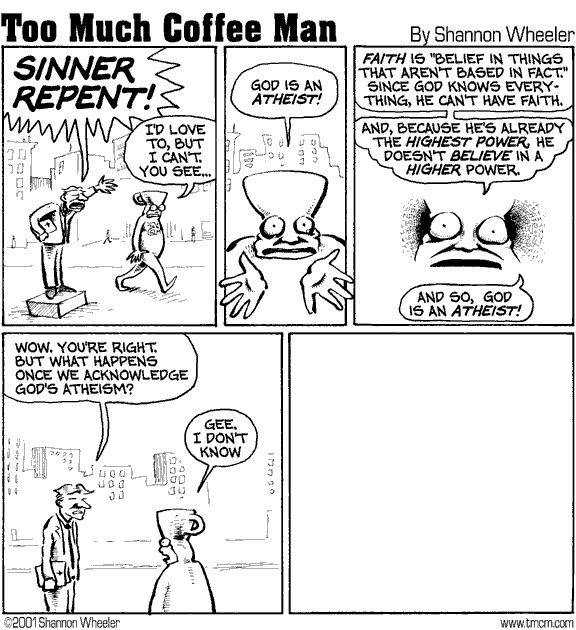
"Damn, I hadn't thought of that, said God, and disappeared in a puff of logic"

I rather like this. If any theists wish to argue it, their challenge is to define "faith"

God is an atheist (Too Much Coffee Man).

Search This Blog